4 min read
From Policyholder to Health Consumer
Patients now shop like consumers: what BCG's survey means for regulated health teams
Think about the last time you booked a flight or returned a parcel. It took minutes, you knew where you stood, and nobody asked you to call back between nine and five. Now ask yourself how health members, patients or policyholders experience a simple request to you. That gap is the story behind a new BCG study on the consumerisation of health care, published in November 2026.
For leaders in health insurance, healthcare services and other regulated businesses, the findings are both a warning and an opportunity. Retail, banking, and AI assistants are setting expectations rather than other insurers or providers. This article outlines what BCG found, how far the trend really goes, and how regulated organisations can respond without compromising compliance or clinical accountability.
The numbers behind the shift
The research, led by BCG, surveyed 9,914 consumers across ten markets in July and August 2026: Brazil, China, France, Germany, India, Japan, Switzerland, the UAE, the UK and the US. About half of respondents see health care products as just another consumer good. Around 67% want more control over their health care choices, and more than 60% expect retail-store levels of convenience.
BCG built a consumerisation index from zero to 100. China scored 72, India 66, the UAE 63 and Brazil 62, with Japan the lowest. Consumerisation is strongest in fast-growing markets where more health spending is paid out of pocket, and weaker in Western Europe where public funding is higher.
Age matters too. Among Gen Z, 52% see health products as consumer goods, as do 53% of millennials, against 41% of Gen X and 31% of boomers. Income also plays a part: 48% of higher-income respondents would pay out of pocket for products such as GLP-1 drugs, against 31% of lower-income respondents. In short, the people who will be members for the next 30 years already expect to be treated as customers. Those expectations will not wait for the next system upgrade, so it is wise to plan for them now rather than react when complaints and lapses begin to rise.
Self-service and speed are now part of the product
If consumer experiences set expectations, response time and clarity are no longer back-office metrics. They are part of what customers believe they bought. BCG notes that millennials (52%) and Gen Z (47%) prefer instant AI or online answers, compared with 25% of boomers. These customers will find an answer somewhere. The only question is whether it comes from you.
BCG's separate paper on insurance makes the same point from the insurer's side. Yohei Takabe, Sebastian Schmöger and colleagues write that customers increasingly use AI tools to research coverage and compare providers, so insurers must be discoverable, conversational and eventually transactional. For health and supplementary cover, that means a member should be able to check a benefit, submit a claim or change a detail at any hour and see it resolved.
This is the territory of Conversational Process Automation. Spixii presents its platform as self-service for regulated businesses, available 24/7, designed for high-value requests that web forms and GenAI cannot handle, with first-contact resolution as a key metric. The point is not a friendlier chatbot. It is a governed process that finishes the job in the first conversation, in the customer's preferred language. Because processes can be cloned for other languages while reusing the same core integrations, serving a new market takes less effort than starting again.
Health is not retail
It would be a mistake to take the consumer analogy too far, and BCG is careful not to. Regulators, clinicians and compliance teams exist for good reasons. Its authors note limits such as prescription requirements, clinical complexity and insurance design. Full consumerisation of health care is unlikely. Digital fluency also does not remove the value of human guidance for high-stakes decisions, and digital-first models can exclude some patients or fragment care.
Misinformation is also a risk. Instant answers are only valuable when they are right, and in regulated settings a wrong answer is a compliance event, not merely a poor experience. BCG's insurance paper reinforces the human side: a disputed claim or a serious health condition may call for a person who can understand context and explain options.
The sensible reading is not to replace people but to protect their time. Let well-defined routine requests be completed through governed self-service, and route the sensitive, ambiguous or emotional cases to colleagues with the full context already captured. Agent-assist tools, which BCG says have delivered efficiency gains of 20% to 50% in early implementations, can then help those colleagues spend more time on the conversations that matter.
Conclusion
Patients and members are behaving more like consumers, especially younger and higher-income groups and those in markets with higher out-of-pocket spend. That does not turn health into retail, but it does change what people expect from the organisations that serve them: control, convenience and answers that arrive when they ask.
For regulated businesses, the winning move is to make routine requests effortless and fully compliant, while keeping skilled people available for the moments that need judgement and empathy. It is a modest step, but it turns a vague trend into a practical plan. Start by listing the five requests members raise most often, measure how many can be resolved at first contact today, and decide which one can be completed through one governed conversation. That exercise will show how far the gap is from the consumer standard and what to fix first.
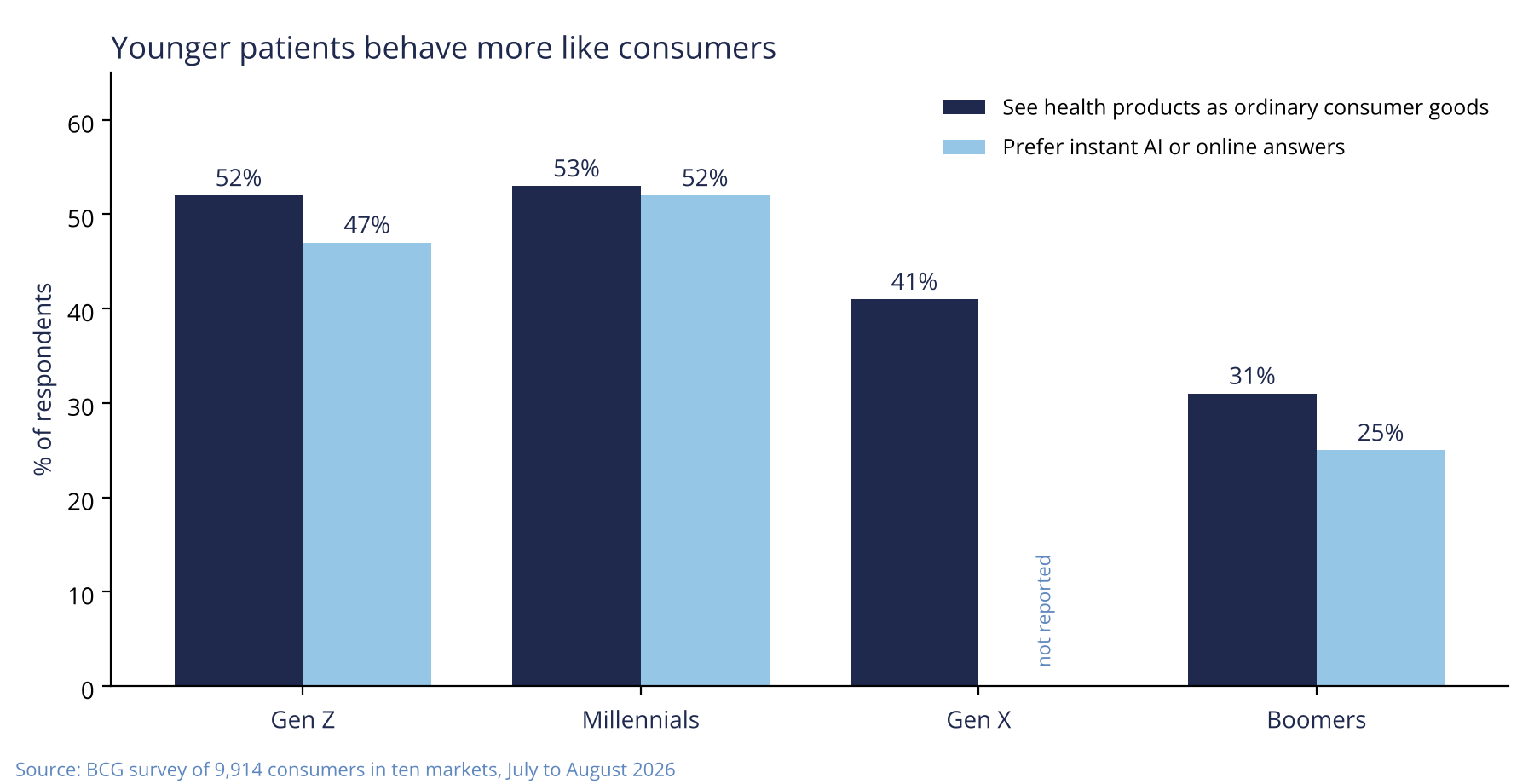
Figure 2. Generational attitudes to health care as a consumer product. Source: BCG, The Consumerization of Health Care (November 2026). Chart recreated by Spixii from the source figures; Gen X figure for instant AI answers not reported.
FAQ
What is health care consumerisation?
BCG defines it as growing consumer needs that shape how people seek, choose, and engage with care. Patients increasingly want control, convenience and direct access, and many see health products as ordinary consumer goods, particularly in younger age groups. This is accelerated by AI tools.
How many people expect retail-level convenience in health care?
In BCG's 2026 survey of 9,914 consumers across ten markets, more than 60% expect retail-store levels of convenience, and 67% want more control over their health care choices. Expectations are highest in fast-growing markets such as China, India, the UAE and Brazil.
Which generations are most consumerised in health?
BCG found 53% of millennials and 52% of Gen Z see health products as consumer goods, compared with 41% of Gen X and 31% of boomers. Younger groups also prefer instant AI or online answers. Higher-income groups are also more consumerised, so segment the approach and test it with real members.
Will consumerisation replace human care?
No. BCG says full consumerisation is unlikely because of prescription rules, clinical complexity and insurance design. Human guidance remains valuable for high-stakes decisions, and digital-only models can exclude some patients or fragment their care. Balance agency with protection of quality and equity.
How can regulated health organisations respond?
Offer governed, round-the-clock self-service for routine, well-defined requests, measure first contact resolution, and route complex or sensitive cases to people with full context already captured. This improves speed and member experience without weakening compliance, audit trails or clinical accountability.
Want to see how compliant conversational automation can reduce your cost to serve? Talk to Spixii about your health insurance journeys.