4 min read
Premiums Up, Profits Flat: Why Insurers Are Treading Water
Imagine a business whose sales have grown every year for twenty years, yet whose profits have quietly slipped behind. No crisis, no collapse, just a slow leak. That is the story of the global insurance industry.
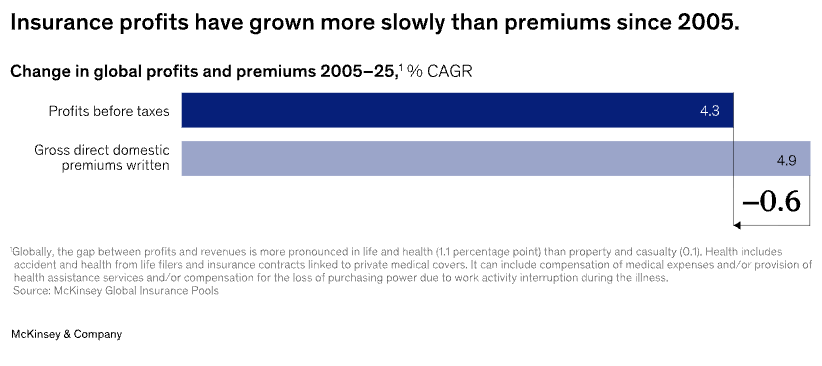
According to McKinsey's July 2026 report, How AI will reshape the economics of insurance: A CEO's guide to strategy, gross written premiums have grown by roughly 4.9% a year since 2005, reaching an estimated $8.3 trillion in 2025. Profits before tax grew by only about 4.3% a year over the same period, to around $580 billion. The gap looks small. Compounded over two decades, it is the difference between an industry that scales and one that simply gets bigger.
So why are insurers working harder for proportionally less? And what does it mean for leaders of any regulated business, where compliance, legacy systems and caution shape every decision?
Two decades of treading water
McKinsey describes the past twenty years as a period in which the insurance industry has been treading water. Premiums have grown steadily, but operating leverage has eroded across property and casualty (P&C), life and health. In plain terms, each extra pound of premium has brought in a little less profit than the one before.
The industry has also proved remarkably resistant to disruption. Globalisation, digitisation and platform economics reshaped retail, media and banking, yet barely changed how insurance makes money. McKinsey observes that an insurance executive from 2006 would find the business of 2026 highly recognisable.
Meanwhile, relevance has slipped. Over the past decade, insurance revenues grew 1.24 times, slower than most major industries and slower than global GDP (1.58 times). Personal lines fell from 1.2% to 1% of global GDP between 2019 and 2023, with growth in developed markets driven mostly by rate rises rather than new cover. Aon puts the natural catastrophe protection gap at $133 billion for 2025, and the Financial Stability Institute estimates that less than 1% of global cyber costs are insured, a gap of around $900 billion. Demand for protection is growing. The industry's share of it is not.
Why are insurance profits growing so slowly?
The short answer: costs have grown almost as fast as revenue, so premium growth has not turned into margin. Three forces stand out.
Flat productivity. The average P&C expense ratio has hovered between 27% and 32% since 2005. Leaders run below 22% and laggards at 32%, and technology has widened rather than closed that gap. McKinsey finds that insurance cost ratios are 10% higher globally than in 2005, while telecoms, automotive and airlines have cut theirs materially.
The striking part is that technology did work. Labour productivity rose by 14% in P&C and 24% in life across claims, servicing and policy issuance. But rising IT costs, compliance overhead, and the complexity of bolting digital tools onto legacy operating models absorbed those gains. Efficiency improved, yet average costs still went up.
Expensive distribution. Commissions and acquisition costs take between 10 and 25 cents of every premium dollar in P&C, and up to 80% of first-year premium in life. After claims, distribution is the highest cost in P&C, and commissions have barely moved since 2005. McKinsey's research shows multichannel incumbents carry cost ratios at least 30% higher than pure direct players, almost entirely because of sales and distribution.
Capital and pace. Rising capital requirements have weighed on returns. Product cycles measured in years leave incumbents slow to respond, while AI-native managing general agents build and refine products in weeks.
Is slow profit growth the price of prudence?
There is a fair case that this picture is less damning than it looks. Insurance runs on timescales set by the risks it covers. Actuarial reviews follow the length of the claims tail, and pricing mistakes can take years to surface. Slower cycles and heavier capital buffers are partly the cost of keeping promises to policyholders, which is exactly what regulators expect.
Nor has stability been all bad. McKinsey points out that the industry consistently leads other sectors on dividends and share buybacks, and it proved its worth during the pandemic. The report even sketches a more comfortable future: AI improves productivity at the margins, distribution economics hold, and the question of who owns, distributes and profits from risk stays largely settled.
There are also reasons to be wary of the next promised fix. AI carries real costs for compute, models and orchestration, and McKinsey notes these are already worrying some firms. New digital risks such as systemic cyber and AI liability may be highly correlated, so chasing fresh premium before understanding how losses spread could hurt profits rather than help them.
Yet the evidence suggests the cost of standing still is rising. Domain-level AI transformations are already cutting customer onboarding costs by 20% to 40% and lifting agent productivity by 10% to 20%. AI leaders in insurance have generated six times the total shareholder return of laggards. Prudence explains slow profit growth. It does not excuse it.
What regulated businesses can learn
The slow growth of insurers' profits is not a mystery. It stems from flat productivity, costly distribution, rising capital needs, and operating models built for a slower world. The lesson for any regulated business is uncomfortable: technology layered on top of legacy processes tends to add cost, not remove it.
McKinsey offers not a five-year roadmap but a compass. Decide where to compete, through scale or deep specialisation. Put a senior leader in charge of delivery. Redesign processes, decision rights and governance alongside the technology, and move from pilots to production in two or three high-value areas first.
For regulated firms, one more condition applies: automation must be explainable. Customers, auditors and regulators need to see why a decision was made. The insurers that combine speed with that kind of transparency will be the ones that finally turn premium growth into profit growth. The rest may keep treading water.
Want to see how compliant conversational automation can reduce your cost to serve? Talk to Spixii about your health insurance journeys.