4 min read
AI in 2026: Build or Buy? Let Economics Decide
Nearly one in three organisations has already decided not to buy a software product because AI let them build it instead.
That is one of the headline findings in McKinsey's The State of AI in 2026: On the road to ROI, published in August 2026. Yet only 37 per cent of respondents report any EBIT impact from AI, the same share as last year.
For leaders in pensions and health insurance, the question is no longer whether to use AI. It is where to build, where to buy, and which type of AI belongs where. The short answer: buy or partner where compliance and auditability matter most, build where work is low risk and genuinely differentiating, and let the economics make the final call.
The state of AI in 2026: far more than a chatbot
McKinsey's survey of 1,719 participants across 97 countries shows AI moving beyond experiments. Nearly nine in ten respondents use it regularly in at least one function, and 44 per cent say it is scaling across the enterprise, up from 38 per cent a year ago. Chatbots remain the most widely scaled tool, at 47 per cent. But about two in ten organisations now report scaling AI agents, and a similar share are scaling software coding agents.
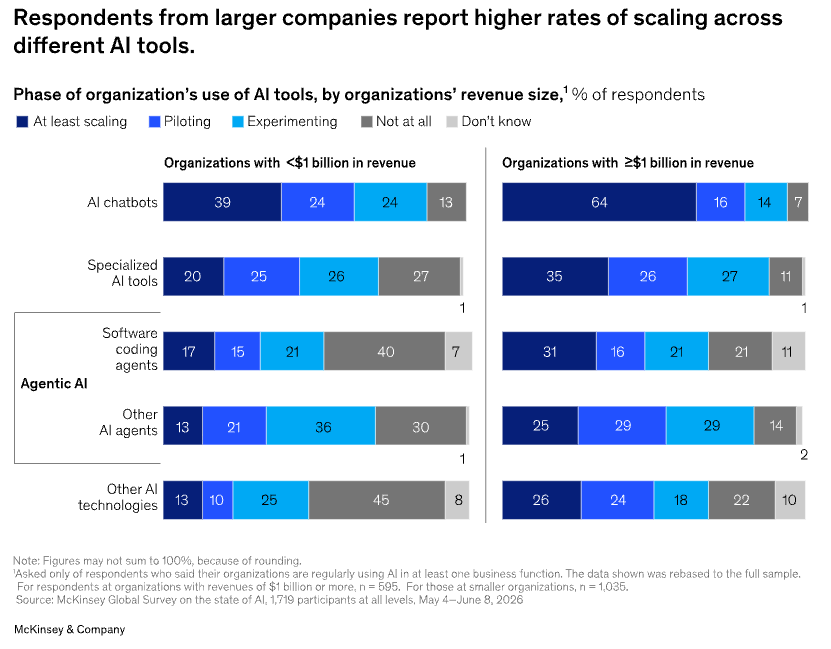
Size matters. Among organisations with more than $1 billion in revenue, 40 per cent are scaling agents, up from 27 per cent. Among smaller firms, the figure has stayed flat at 22 per cent.
The chatbot is the front door, not the whole house. In practice, there are four broad families of AI:
- Generative assistants that draft, summarise and answer questions.
- Agentic systems that act across workflows with some autonomy.
- Coding agents that write and maintain software.
- Deterministic, expert-system AI that follows approved logic and gives the same answer every time.
Each carries a different cost, risk and regulatory profile. Treating them as interchangeable is how budgets leak, and audits go badly.
AI has changed the maths
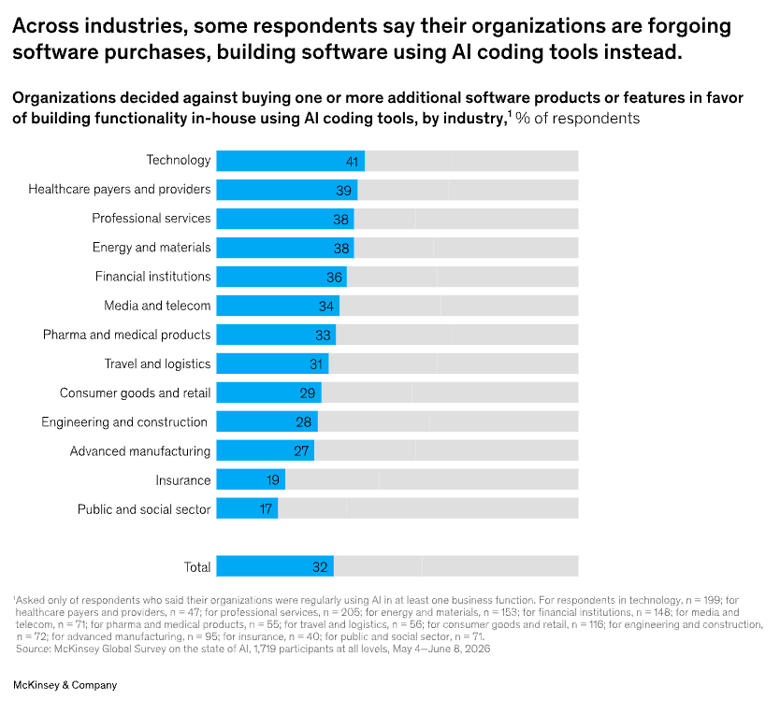
The argument for building has never been stronger. McKinsey reports that 32 per cent of respondents decided against buying at least one software product or feature because agentic coding tools let them build it in-house. Healthcare is among the industries most likely to report this, and among high performers the figure is nearly half.
The appeal is obvious. Prototypes arrive in days rather than quarters, tools fit your process exactly, and licence fees disappear. For internal dashboards, workflow utilities and low-risk automation, building can be a sensible choice.
But the economics are not as simple as the headline suggests. About one in five respondents say AI operating costs, including token costs, have constrained their AI use. High performers report cost constraints on coding agents roughly three times as often as their peers. Building also means inheriting maintenance, security, testing, model drift and, in regulated sectors, the burden of proving to a supervisor exactly how an outcome was reached. The invoice you avoid today can reappear as headcount and risk tomorrow.
In regulated industries, buy for control
probabilistic model that is right most of the time makes an excellent drafting assistant. It is an uncomfortable decision-maker for an eligibility check, a pre-authorisation or a pension member journey. Regulated businesses need consistency, explainability and a clear audit trail, and a model that improvises cannot easily provide them.
McKinsey's findings point the same way. High performers are more likely to actively manage AI-related risks, and nearly three-quarters have fundamentally redesigned workflows rather than bolting AI onto existing ones.
This is where Spixii fits. Spixii builds conversational AI on deterministic, expert-system foundations. Every question, rule and outcome follows logic your own experts have approved, and every step can be traced. In health insurance, that supports guided journeys for onboarding, claims and pre-authorisation that behave the same way every time. For pension providers, it supports structured, step-by-step member interactions where accuracy and consistency matter more than creativity.
The result is a friendly conversational experience on the surface and a controlled, auditable process underneath. Because Spixii focuses on regulated industries, teams avoid rebuilding compliance-grade foundations from scratch, and they can still pair deterministic automation with generative AI where the risk is low.
It all comes back to business economics
The build-or-buy debate is really a question of business economics, shaped by four forces:
- Competition: rivals are scaling AI, and standing still costs money.
- Compliance: regulators expect explainable, consistent and auditable decisions.
- Operating margin: token costs, maintenance and run-rate expenses must be set against the cost of the work being replaced.
- Resources: engineering talent, security expertise and management attention are finite.
McKinsey's conclusion is worth keeping in mind. The organisations that turn individual productivity gains into lasting financial performance are likely to be those that "transform their businesses, not just adopt AI tools." For regulated firms, transformation rarely means building everything alone. It means choosing the right type of AI for each use case, and partnering where control, speed and compliance matter most.