4 min read
How insurance and financial services leaders integrate conversational automation software with core systems for secure, 24/7 self-service
Regulators do not pause for digital transformation deadlines. Neither do customers who expect a policy update, a claim status or a mortgage query answered at 11 pm on a Sunday. For insurance and financial services leaders, that tension sits at the centre of every automation roadmap: how do you deliver true 24/7 customer support without exposing the business to compliance risk?
The answer is not another generic chatbot bolted onto a website. It is conversational automation software built from the ground up for regulated industries, integrated properly with the core systems that actually run the business. This guide walks through how to do that, end to end.
Why regulated firms can't use off-the-shelf chatbots
Most conversational AI on the market was designed for retail and hospitality, where a wrong answer means a refunded coffee. In insurance and banking, a wrong answer can mean an unsuitable product recommendation, a misstated policy term or a breach of consumer duty rules. That is why compliant chatbots need a different foundation: deterministic logic and auditable decision paths, not just a large language model guessing at the best response.
Gartner's research into customer service technology shows how fast this space is moving. In a 2025 survey of customer service and support leaders, Gartner found that the large majority of organisations are exploring or piloting customer-facing generative AI, with many already deploying voice and chat solutions. Yet Gartner also cautions that self-service still resolves only a modest share of enquiries end to end today, which is exactly the gap that purpose-built regulated industries automation needs to close.
McKinsey's analysis of AI in financial services adds the compliance dimension. Its 2025 work on trusted AI compliance notes that institutions still relying on manual compliance processes typically satisfy only a fraction of their regulatory obligations, leaving them exposed to penalties and inefficiency, while firms that automate these controls have pushed compliance coverage from around three-quarters of requirements to well above 95%. That is the business case for building compliance into the automation layer itself, rather than checking it afterwards.
A 5-step integration roadmap
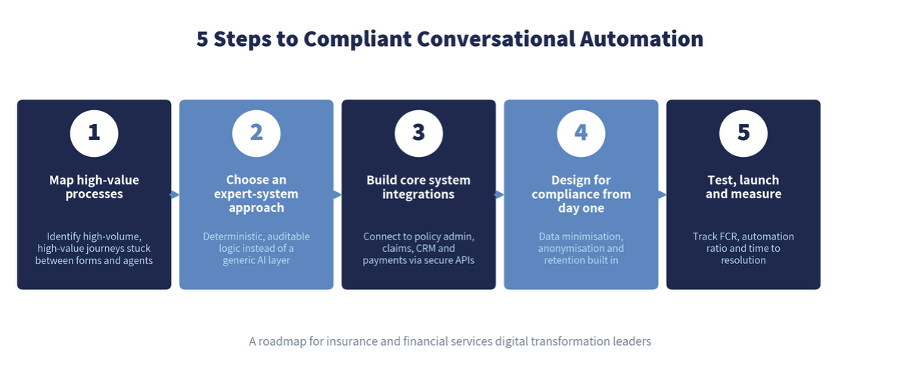
Figure 1: A five-step roadmap for integrating compliant conversational automation.
Step 1: Map the high-value processes worth automating
Not every enquiry needs a conversation. Start by identifying the processes that are high-value, high-volume and currently stuck between an expensive web form and a live agent: policy amendments, claims updates, benefits queries, KYC refreshes. These are the journeys where 24/7 customer support delivers the biggest return, because customers want outcomes, not just answers.
Step 2: Choose an expert-system approach, not a generic layer
Generic conversational AI is probabilistic. For regulated processes, that unpredictability is the risk. Spixii's Conversational Process Automation platform, for example, is built on an expert-systems approach that models the business logic and the conversation simultaneously, so every branch of a customer journey follows a defined, auditable path rather than an open-ended generated response.
This is where a low-code function builder becomes important. It lets digital transformation teams embed underwriting rules, eligibility checks and pricing logic directly into the conversation flow, so the chatbot's decisions match the same logic already governing the core policy administration or claims system.
Step 3: Build core system integrations properly
Compliant conversational automation is only as good as the systems it talks to. A chatbot that cannot check a live policy status or update a claim in the core system is just a glorified FAQ page. Core system integrations need to connect the conversational layer to policy administration, claims, CRM and payment platforms through secure APIs, with clear data ownership at every step.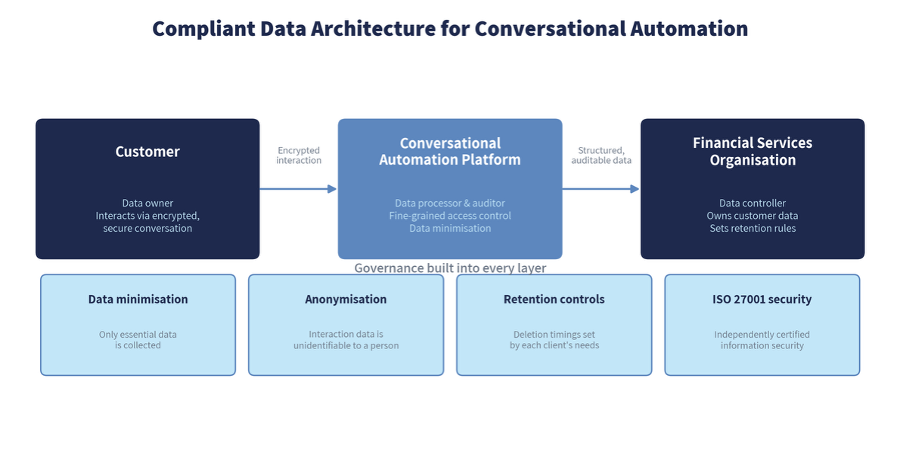 Figure 2: A compliant data architecture for conversational automation in regulated industries.
Step 4: Design for compliance in messaging platforms from day one
Compliance in messaging platforms is not a feature to add later. It must be part of the architecture: data minimisation so only essential information is collected, anonymisation of interaction data wherever possible, and configurable data retention policies that match each client's regulatory environment, whether that is GDPR, the Insurance Distribution Directive, or sector-specific consumer duty rules. Independent certifications, such as ISO 27001 for information security management, give transformation leaders external assurance to bring to their own risk and compliance committees.
Step 5: Test, launch and measure with the right metrics
First Contact Resolution, automation ratio and time-to-resolution matter more than raw conversation volume. A well-integrated deployment should be measurable within weeks rather than quarters. Insights dashboards that track behavioural patterns and feedback let teams refine conversation flows continuously, rather than treating launch as the finish line.
Frequently asked questions
What is compliant conversational automation? It is conversational automation software designed specifically for regulated industries, combining deterministic, auditable logic with direct integration into core systems, so every customer interaction meets legal and regulatory requirements.
How is this different from a standard chatbot? Standard chatbots generate responses probabilistically. Compliant chatbots for insurance and banking follow structured, expert-system logic that mirrors the underlying business rules, making outcomes consistent and auditable.
Can conversational automation really run 24/7 in a regulated environment? Yes, provided the platform is built with data governance, encryption and access controls from the outset, rather than added as an afterthought once a generic chatbot is already live.
Looking forward
Regulated firms don't need to choose between speed and compliance. With the right conversational automation software, proper core system integrations and a genuinely compliant architecture, insurance and financial services organisations can offer secure, always-on self-service that keeps both customers and regulators satisfied.