2 min read
Today most financial services companies know about Robotic Process Automation (RPA). RPA has been in the market for 20 years, and companies now have in-house automation teams trained to build and maintain such robots themselves directly. Yet, only a few know about Conversational Process Automation (CPA).
So, in this week’s blog, we answer the questions:
- What is CPA?
- What is the link between RPA and CPA?
- How can they be deployed into a cohesive self-serve automation strategy?
What is RPA?
RPA appeared in the market in 2003 with Blue Prism's first commercial product, “Automate”. Since the appearance of this technology, the execution of middle-office and back-end processes has changed drastically.
RPA is an application of technology aimed at improving business processes through automation. It usually leverages robots that automate the tasks of existing processes. This ultimately reduces process inefficiencies and improves their performance at a fraction of the cost. The business processes here are middle and back-office processes i.e. passing the information from one system to another or sending a confirmation letter to a customer following the request from a customer service agent.
Such robots also eliminate unnecessary human manual input in various steps of the business process. They are usually applied to execute well-defined, high-volume, repetitive and routine tasks. Every process that is not too complex, well-understood, and well-documented with local rules makes a good prospect for RPA.
RPA relies upon structured data inputs; clear input will trigger a waterfall of automated tasks. As such, RPA has achieved stellar results in regard to saving costs on the execution of the middle and back-office processes.
Despite this, RPA has a glaring limitation: very often, business processes start with customer-facing interactions. This often translates into unstructured data that RPA cannot handle directly.
This is precisely the gap CPA fills in.
What is CPA?
Conversational Process Automation (CPA) made its appearance in 2016. It focuses on the end-to-end automation of high-value services. CPA is made of three core modules:
- Chatbots
- Conversational processes
- Systems integrations
.png?width=1674&height=1530&name=Conversational%20Process%20Automation%20(CPA).png)
As RPA sits in the 3rd module of Systems integrations, CPA can be seen as the complementary solution working in symbiosis with RPA since it can:
- Execute high-value services following specific business processes in a compliant way
- Offer an intuitive customer-facing interface using conversations with chatbots
- Structure the information gathered from users and wrap it into a format digestible to RPA
CPA is a powerful solution that not only captures customer input but also provides advanced analytics to inform businesses about the performance of the process with reporting dashboard and map of conversational paths. This allows the generation of business intelligence while giving the means to quickly adapt to changing customer expectations through an evidence-based approach grounded on empirical data.
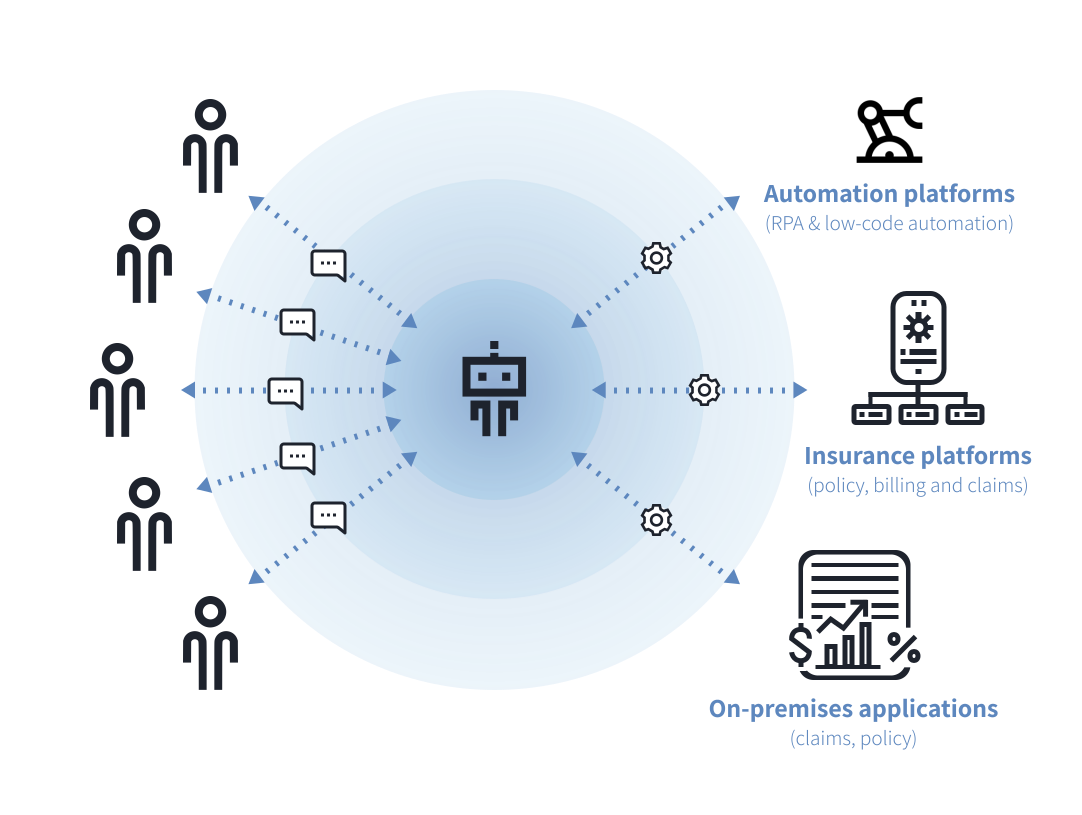
CPA: the ideal interface between customers and insurers' back-end systems
In conclusion
With the challenging resources environment and growing demands from customers, the key focus in 2023 remains to automate high-value processes in companies, especially for insurance and financial services companies. The automation of such processes started in the back office and is progressing towards the front office by enabling customers to self-serve directly. CPA is the critical component to support this strategy as it complements RPA and the other systems integrations tools. As data from customer-facing processes is often unstructured, CPA generates advanced analytics that gives relevant knowledge to businesses for continuous improvement.
Businesses and customer expectations have evolved far beyond. CPA has been built to give businesses the ability to meet both present and future needs.